Schema Therapy for Neurodiverse Clients: From Neurobiology to Techniques Online training – simultaneous translation 7-9.12.2024 About the training Schema therapy assumes that not only negative childhood experiences but also biological
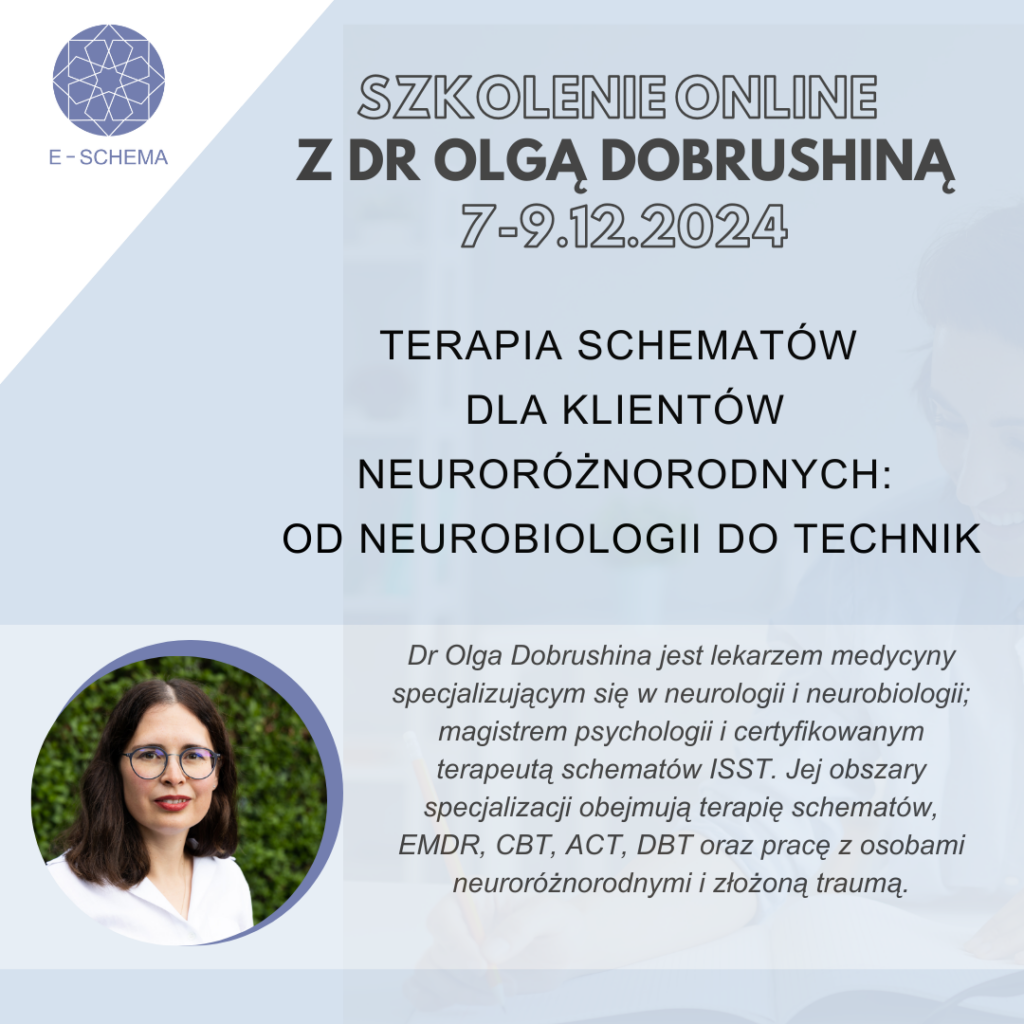
Schema Therapy for Neurodiverse Clients:
From Neurobiology to Techniques
Online training – simultaneous translation
7-9.12.2024
About the training
Schema therapy assumes that not only negative childhood experiences but also biological factors influence the development of schemas and modes. The interaction between an individual’s neurobiology and social environment is complex, especially for neurodivergent clients. Understanding how a person’s brain works is crucial to the success of psychotherapy. The most common forms of neurodiversity, ADHD and autism, account for up to 10% and 3% of the population, respectively, and these rates are much higher among people with chronic, refractory mental disorders—those who seek Schema Therapy as an alternative approach.
Studies show that neurodiversity is associated with dramatically increased risk of mental disorders and poorer outcomes in psychotherapy. People with ADHD or autism often report feeling misunderstood by therapists who try to change their way of being or use techniques that do not make sense to them and do not help. Therefore, therapists should pay special attention to identifying and addressing neurodiversity.
We believe that Schema Therapy, a flexible, relationship-based, trauma-focused approach, can be an ideal solution for neurodivergent clients. In this three-day course, we will learn to recognize the biological factors behind clients’ schemas, modes, and problems. The knowledge and skills gained will enable therapists to understand the unique neurology and neurobiology of their clients and effectively use Schema Therapy to help neurodivergent individuals.
Course of training
The training will take place on December 7-9, 2024. Each training day will begin at 10:00 and last until 17:30. There will be two 15-minute breaks and a one-hour lunch break.
On the first day, we will discuss neurobiological concepts that schema therapists can draw on when working with both neurodiverse and neurotypical patients. We will move from understanding to practice, learning to conceptualize patients’ difficulties in the context of neurological systems and adapt therapy accordingly.
On the second day, we will delve into the world of neurodiversity to identify and adapt to clients with autism and ADHD. We will discuss topics such as dual empathy, masking, burnout, and phenomena such as meltdown, shutdown, and rejection sensitivity dysphoria. Cases, video examples, and memes will help us understand the nuances of neurodiversity. As good “reparents,” we will learn to meet the special needs of neurodivergent clients, including sensory needs.
The third day will focus on adapting Schema Therapy for neurodivergent clients, using two simulated cases. We will protect autistic Mary from an ableist critic and help Peter with ADHD learn to regulate better than his demanding critic. We will use Contextual Schema Therapy to recognize the multifaceted coping mechanisms of masking and understand and meet the needs behind them. Finally, we will see how happy a neurodivergent child can be when they are understood and supported, rather than molded into a neurotypical person.
Who is this training for?
The workshop is suitable for a range of mental health professionals including psychologists, psychiatrists, counsellors, psychotherapists, social workers, and occupational therapists. The first two days can be attended by professionals working in any therapeutic profession and researchers. The third day is intended for those with a working knowledge of schema therapy.
Training price
The price for three days of training is PLN 1,400 gross.
Enrollment: please email the training coordinator Magdalena Kitlowska kitlowska@gmail.com
Where will the training take place?
The training will be conducted online on the Zoom platform. Each accepted participant will receive a link to the meeting before the training begins.
About the host

Dr. Olga Dobrushina is a registered psychologist with the HCPC (PYL044166) and a certified Schema Therapist (ISST 60360358). Her work is primarily based on Schema Therapy and EMDR, incorporating techniques from classical CBT, ACT and DBT. Dr. Olga Dobrushina supports clients with a variety of mental health conditions, with a particular focus on neurodiversity and complex trauma, and her work is distinguished by its unique and interdisciplinary
an approach resulting from her extensive experience in psychology, neurobiology and neurology.
In 2008, Dr. Olga Dobrushina received her medical degree from the M.V. Lomonosov Moscow State University. She worked as a medical doctor for fourteen years, specializing in intensive care and neurology. Her professional experience includes working as a doctor in neurointensive care, inpatient and outpatient neurorehabilitation, as well as managing a psychosomatic clinic and establishing and running an interdisciplinary psychosocial center for neurodiverse people (autism, ADHD, dyslexia, dysgraphia, after-effects of brain injuries, strokes, brain tumors).
Interested in the cognitive and emotional aspects of medical conditions, Dr. Olga Dobrushina trained in neuropsychology and psychotherapy. In 2021, she completed a master’s degree in psychology at the Moscow State University of Psychology and Education, and psychological therapy became her main professional area. In 2022, Dr. Olga Dobrushina moved to Israel, where she has a medical license, and in 2024, she moved to the United Kingdom. There, she works as a psychologist, using her extensive medical and scientific knowledge.
Dr. Olga Dobrushina combines clinical work with research in neurobiology. She obtained her Ph.D. in 2012. Her research explores the connections between body sensation (interoception), emotional processing and brain disorders, with the aim of developing technological and psychological therapies that improve psychological well-being. She is currently associated with the Laboratory for Innovation in Autism at the University of Strathclyde in Glasgow.
She is the author of 28 scientific articles and has presented at numerous international conferences. Her teaching experience includes co-organizing internships in neuropsychological rehabilitation for psychology students, lecturing on psychosomatics, human physiology and research methods in neurobiology, as well as conducting postgraduate training in neurotechnology and psychotherapy for neurodiverse clients.
Dr. Olga Dobrushina is accredited in individual Schema Therapy (ST) and is in the process of obtaining advanced ISST accreditation under the supervision of Eckhard Roediger. She has also completed additional training in couples therapy and child and adolescent therapy. She also has experience in group Schema Therapy and plans to train in this area.
